I was somewhat curious about how robo-advisors work, so I researched a bit. Wealthfront, a popular robo-advisor in US, publishes its methodology, so I will read and summarize it for my own understanding.


How Investment Flows
- Determination of Asset Classes
- Decide which assets to invest in, such as US Stocks/Emerging Bonds/Real Estate etc.
- Determination of Investment Targets
- Decide which ETF to invest in for each asset type
- Calculation of Expected Returns
- Calculate how much return each asset class is predicted to bring in future
- Calculation of Volatility and Correlation for each Asset Class
- Compare each asset class to analyze which risk is higher, and whether there is correlation between asset classes
- Portfolio Construction
- Calculate portfolio for each risk tolerance from results of 3 and 4
- Selection of Optimal Portfolio from User’s Risk Tolerance
- Analyze user’s risk tolerance from questionnaires etc. and decide portfolio from results of 5
- Periodic Portfolio Rebalancing
- Review asset allocation periodically at timing when market environment changes
1. Determination of Asset Classes
Decide how to divide financial assets in market as below. This is to decide which product to buy and how much to buy in divided units.
For example, classification method like below can be raised, but from here it can be further subdivided into Emerging countries, Developed countries, US etc., or include Real Estate/Gold etc.
- Stocks: Cover domestic and foreign stock markets, diversify investment into various companies.
- Bonds: Include bond markets providing stable revenue like government bonds and corporate bonds.
- Inflation Assets: Assets to respond to inflation, for example including inflation-linked bonds.
2. Determination of Investment Targets
For each asset class decided in 1, decide ETF to purchase. Reason for selecting ETF is to obtain effect of diversified investment with low cost.
Choose ETF considering elements like below. In other words look for ones maximizing cost efficiency and market performance.
- Cost: Prioritize low fees.
- Tracking error: Choose one with small tracking error against index.
- Liquidity: Choose one with high trading volume and easy to trade.
- Securities lending: Select ones where securities lending revenue can be obtained.
3. Calculation of Expected Returns
Flow of process in this phase is ↓.
- Calculation of Expected Return Before Tax
- Calculation of Expected Return After Tax (Tax Loss Harvesting)
3-1. Calculation of Expected Return Before Tax
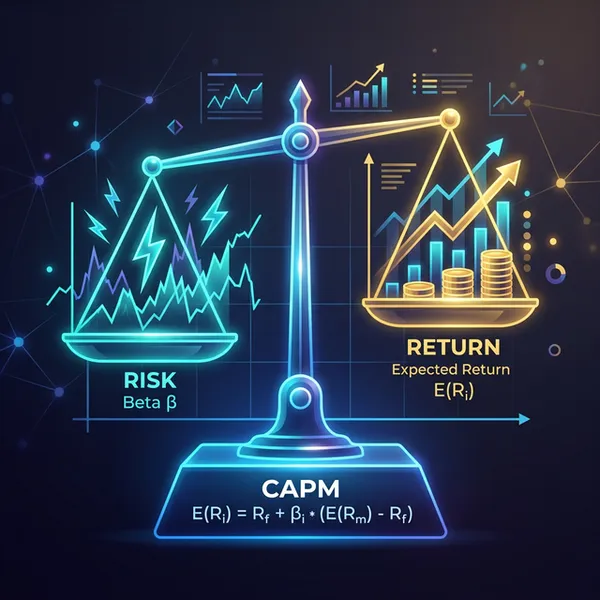
Using Black-Litterman model, calculate expected return combining expected return calculated from Capital Asset Pricing Model (CAPM) and long-term expectation obtained from Wealthfront Capital Market Model.
Specifically calculate in following 2 steps.
- reverse optimization: Calculate expected return of each asset class with CAPM.
- Bayesian approach: Blend expected return obtained in 1 with expected return prediction obtained from multi-factor Wealthfront Capital Market Model (WFCMM).
Thus calculate expected return before tax is deducted.
3-2. Calculation of Expected Return After Tax
In US, since tax rates may differ for dividends, interest, capital gains, adjust asset allocation to maximize return after tax.
In Japan I feel tax rates were same for dividends and capital gains so skip reading (Embarrassing if wrong…)
4. Calculate Variance-Covariance Matrix (Calculate volatility and correlation of asset classes)
Estimate return unique to each asset class using factor analysis, and calculate standard deviation and correlation matrix from unique return. Looking at results, you can know contents like following.
Estimation results of Standard Deviation (Risk):
- Stocks generally have higher risk than bonds.
- Foreign stocks have higher risk than US stocks.
- Even within same asset class, there is large variation in risk (e.g. US Treasury vs US Corporate vs Emerging Market Bonds).
- Investment concentrated on specific asset (Real Estate or Commodities) has little diversification and high volatility.
Estimation results of Correlation:
- Correlation between US stocks and US bonds is almost zero, meaning bonds are good diversification means for stock investment.
- Correlation between stocks of different countries is increasing recently, reflecting progress of global integration of economy and capital markets.
- Correlation with stocks differs by bond type: US Government Bond is zero, US Corporate Bond is slightly positive, Emerging Market Bond has very high correlation. This reflects increase in credit risk of these bonds.
5. Portfolio Construction
Decide optimal portfolio from expected return obtained in 3, and risk and correlation obtained in 4.
Here apply minimum allocation rate and maximum allocation rate to prevent bias. (Specific values are listed in Table 6 of source) Allocation rates here seem to be rule of thumb.
6. Selection of Optimal Portfolio from User’s Risk Tolerance
Instead of 25 questions traditional financial advisors perform, identify risk tolerance with just few questions utilizing behavioral economics research.
Evaluation contents are below.
- Subjective Risk Evaluation:
- Evaluate how much risk investor is willing to take, and consistency of that answer.
- Lower the consistency, lower the investor’s risk tolerance is evaluated.
- Objective Risk Evaluation:
- Estimate if enough money will be saved for spending needs after retirement.
- More surplus income allows taking more risk.
Combine 2 evaluations to make final evaluation, but at this time put weight on more risk-aversive elements. This is because research in behavioral economics shows investors tend to overestimate true risk tolerance.
Check periodically if client’s financial situation changed, and perform rebalancing appropriately.
7. Periodic Portfolio Rebalancing
Depending on market movements, composition of portfolio fluctuates, and asset allocation of portfolio may become non-optimal (e.g. ratio of high-risk assets increases). To maintain intended risk level and asset allocation, change asset allocation periodically.
Conclusion
Since there are many parts I didn’t understand, I hope to revenge again after studying around statistics…
Also I feel specific parts of calculation are skipped quite a bit, but it can’t be helped since it’s commercial…
Appendix
Wealthfront Capital Market Model (WFCMM)
It is known that CAPM explains expected returns of different types of stocks (e.g. Small Cap vs Large Cap, Value vs Growth) and whole asset classes only incompletely, and WFCMM is multi-factor model born to solve this. I don’t understand well but since it’s factor model, probably calculation formula similar to Barra model.
It is multi-factor model where risk premium fluctuates based on changes in interest rates and valuation ratios, showing long-term expected returns. (Using interest rates and valuation ratios as factors??)
Tax Loss Harvesting
In US, since tax rates differ for dividends, interest, capital gains respectively, adjust asset allocation to maximize return after tax.
In case of US, taxation of financial assets is complicated as below.
- Dividends and Interest are taxed at ordinary income tax rate, taxed at distribution.
- “Qualified Dividends” are taxed at long-term capital gain tax rate.
- Municipal bond interest is tax-free for federal tax, state tax (if issued by resident state).