After reading The Attention Fix, I picked up another Anders Hansen book, The ADHD Advantage. Some of the ideas overlap, but this time ADHD is the focus.
It gave me a way to look at why my concentration varies so much and reconsider the conditions that actually help me focus.
Bored easily, absorbed by what interests me
The book explains that people with stronger ADHD traits may have reward systems that respond less to ordinary levels of stimulation, making stronger stimulation and faster rewards more appealing. When attention shifts from a boring task to something new, weak willpower is not the whole explanation; dopamine and reward processing may play a part. This overlaps with the discussion of dopamine in The Attention Fix.
The book also discusses hyperfocus, where someone becomes intensely absorbed in something interesting, and the sudden concentration that appears just before a deadline. Once the pressure creates urgency, the brain finally gets enough stimulation. I know this pattern well. I would rather fix it.
Distraction and wider-ranging ideas
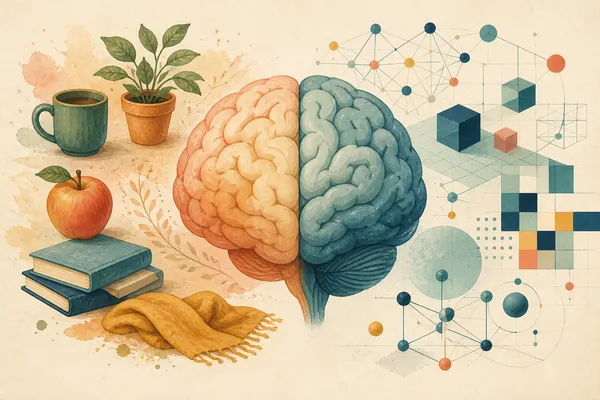
One of the more interesting ideas in the book’s discussion of strengths was the default mode network, or DMN. It tends to become active when we are not focused on a specific task and is involved in free association and creative thought.
In people with ADHD, studies have also found that the DMN and attention networks may not switch cleanly during a task. The tendency that interferes with focus and the tendency that lets ideas range more widely may be two sides of the same coin.
The book also introduces research linking “leaky attention,” the tendency to pick up irrelevant stimuli, with creative achievement. The study did not focus only on people with ADHD, and it does not mean that being more distractible automatically makes someone more creative. Information that would normally be discarded can sometimes become raw material for an idea. That is about as far as I would take it.
When I get stuck, I can switch to washing dishes or cleaning. I can also let my mind wander with the kind of background noise I would hear in a cafe. Neither reliably turns on the DMN, but I want to see whether either works for me.
A little skeptical of “ADHD as a strength”
Some parts of the book seemed designed to catch the reader with the promise, “You might have this talent too.” Saying that people with ADHD are creative is too broad. Everyday difficulties do not neatly transform into talents either.
The same trait can be an advantage or a burden depending on the environment. That interpretation felt about right to me.
Once again, the answer is “exercise”
As in The Attention Fix, the main recommendation here is exercise.
One small study did genuinely surprise me: children with ADHD performed better at a video game after running for five minutes. It is not a substitute for treatment, but moving before I start work is simple enough to try.
Finding the conditions that help me focus
AI-era work has no shortage of new stimuli. Progress updates from agents, notifications, generated code, and the next tool I want to try keep arriving without pause. That is useful for avoiding boredom, but it makes sustained attention fairly difficult.
When focus is not happening, I can break the work into smaller pieces, add small rewards, and move my body before I start. I want to create conditions that make it easier for my brain to get going. That was my main takeaway from The ADHD Advantage.